


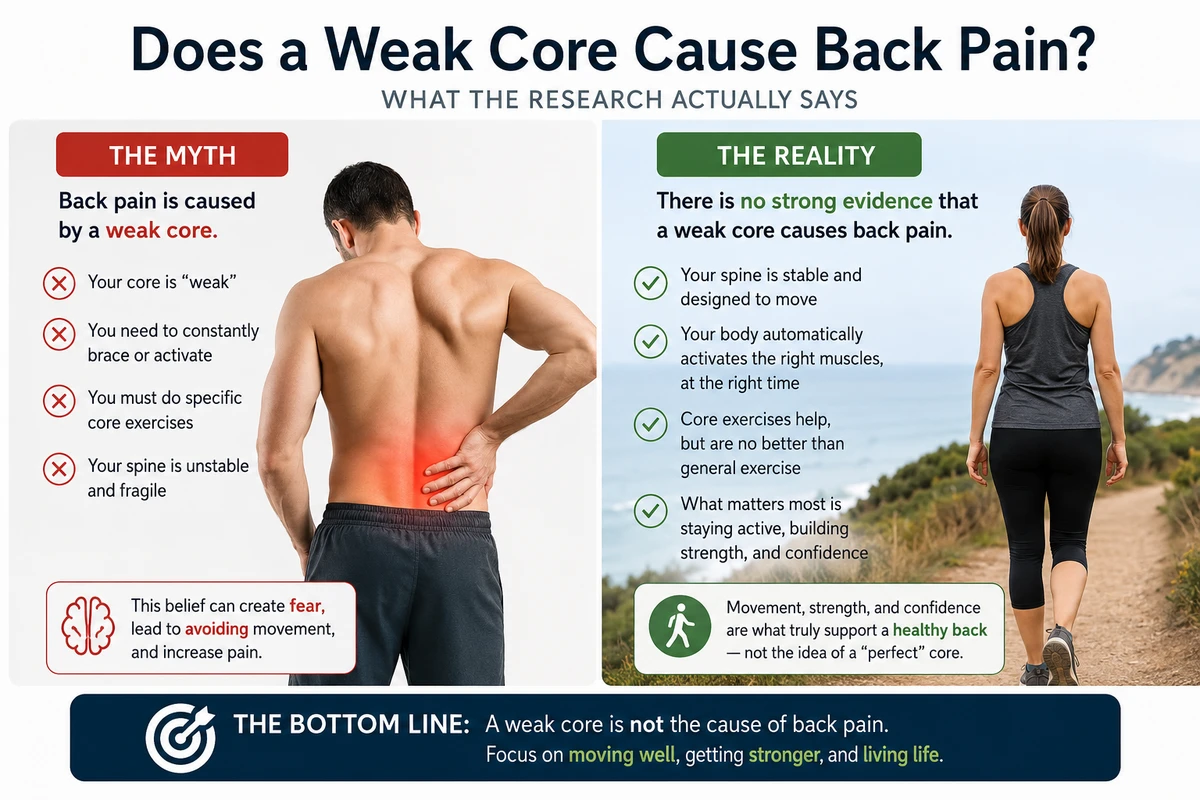
Does a Weak Core Cause Back Pain? What the Research Actually Says
If you’ve ever experienced low back pain, there’s a good chance you’ve been told you have a “weak core.” You may even have been prescribed planks, abdominal bracing exercises, or told to “switch on” your deep core muscles before moving.
It’s one of the most common explanations given for back pain.
But is it actually true?
Over the past 30 years, researchers have spent countless hours studying the relationship between the core muscles and low back pain. Surprisingly, the evidence doesn’t support the simple idea that a weak core causes back pain or that core exercises are superior to other forms of exercise.
Let’s look at what the research tells us.
What Is Your “Core”?
The term core usually refers to the muscles surrounding your trunk, including:
- The transversus abdominis
- Multifidus
- Rectus abdominis
- Internal and external obliques
- Diaphragm
- Pelvic floor
- Back extensor muscles
Together, these muscles help transfer force, maintain balance, support breathing, and allow you to move efficiently.
The important point is that your core is designed to work automatically.
Every time you stand up, walk, cough, laugh, reach for something, or lift an object, your brain coordinates dozens of muscles without you consciously thinking about them.
The Myth of the “Weak Core”
The idea that most back pain is caused by a weak or “inactive” core became popular in the 1990s after early research showed that some people with back pain activated certain deep trunk muscles slightly differently than people without pain.
This led to the belief that muscles such as the transversus abdominis and multifidus needed to be specifically retrained through “core activation” exercises.
While this theory sounded promising, decades of further research have shown the relationship is far more complex.
People with back pain often display different muscle activation patterns, but these differences vary enormously between individuals.
Some people activate these muscles earlier.
Others activate them later.
Some activate them more strongly.
Others less.
There is no single pattern that consistently explains back pain.
Researchers now believe these changes are more likely to be adaptations to pain rather than the cause of pain.
Is There Such a Thing as a Weak Core?
Of course, some people are stronger than others.
Athletes generally have stronger trunk muscles than people who are sedentary.
However, having relatively less abdominal strength does not mean you have a “weak core” that is causing your back pain.
In fact:
- Many people with excellent core strength still develop back pain.
- Many people with average or below-average strength never experience back pain.
- There is no universally accepted clinical test that can diagnose a “weak core” as the cause of low back pain.
This is one of the biggest misconceptions in modern musculoskeletal care.
Back pain cannot be explained by the strength of one muscle or even one group of muscles.
Your Spine Is Much Stronger Than You Think
Sometimes patients are told their spine is unstable and needs stronger core muscles to protect it.
This can sound frightening.
Fortunately, it isn’t how the body works.
Your spine is supported by bones, discs, ligaments, muscles, and most importantly, an incredibly sophisticated nervous system that constantly adjusts muscle activity without conscious effort.
You don’t need to think about activating your transversus abdominis before picking up a shopping bag.
Your brain has already organised this for you.
The human body has evolved to move.
Do Core Exercises Work?
Yes.
Core exercises can reduce pain and improve function in many people with low back pain.
The important question isn’t whether they work.
It’s whether they work better than other types of exercise.
This is where the evidence becomes interesting.
Large systematic reviews and meta-analyses consistently show that core stability exercises are no more effective than general exercise programs for most people with non-specific low back pain.
Walking, resistance training, Pilates, yoga, swimming, and general strengthening programs all produce similar improvements in pain and function.
This is good news.
It means you don’t have to perform complicated “core activation” drills if you dislike them.
The best exercise is usually the one you enjoy enough to continue doing.
Why the “Weak Core” Message Can Be Harmful
Being told that your pain is caused by a weak core or an unstable spine can unintentionally create fear.
Many people begin believing that:
- Their back is fragile.
- They must brace before every movement.
- Bending is dangerous.
- Lifting will damage their spine.
- One wrong movement could cause another injury.
Research shows these beliefs can actually contribute to ongoing pain by increasing fear, muscle tension, and avoidance of normal movement.
This is known as the nocebo effect—when negative beliefs or explanations lead to worse outcomes.
Pain is influenced not only by our tissues, but also by our nervous system, beliefs, expectations, sleep, stress, physical activity, previous experiences, and many other factors.
What Does Help Back Pain?
Current clinical guidelines consistently recommend:
- Staying physically active.
- Gradually returning to normal movement.
- Strengthening the body in ways you enjoy.
- Improving general fitness.
- Building confidence in your back.
- Addressing sleep, stress, and lifestyle factors.
- Learning that pain doesn’t always mean damage.
This approach is supported by decades of research and is far more effective than searching for one “switched off” muscle.
Our Approach at Sydney Chiropractic & Massage
At Sydney Chiropractic & Massage, we don’t diagnose patients with a “weak core” based on a single movement test or assume one muscle is responsible for their pain.
Instead, we recognise that low back pain is usually influenced by a combination of factors, including muscle tension, joint stiffness, movement habits, physical conditioning, stress, sleep, and nervous system sensitivity.
Treatment may include hands-on muscle therapy, chiropractic care, education, and an individualised exercise program—but the goal isn’t to “fix” a weak core.
The goal is to help you move with greater confidence, become stronger overall, reduce unnecessary fear, and return to the activities that matter most to you.
The Bottom Line
The research is clear:
A weak core is not considered a primary cause of non-specific low back pain, and there is no convincing evidence that people need to isolate or “switch on” specific deep abdominal muscles to recover.
Core exercises can certainly be part of a successful rehabilitation program—but they are not superior to general exercise.
Rather than searching for one weak muscle, a better approach is to keep moving, become stronger overall, stay active, and choose exercises you enjoy and can perform consistently.
Your back is stronger, more adaptable, and more resilient than you may have been led to believe.
References
- Smith BE, Littlewood C, May S. An update of stabilisation exercises for low back pain: a systematic review with meta-analysis. BMC Musculoskeletal Disorders. 2014.
- Owen PJ, Miller CT, Mundell NL, et al. Which specific modes of exercise training are most effective for treating low back pain? A network meta-analysis. British Journal of Sports Medicine. 2020.
- Peter O’Sullivan, Caneiro JP, O’Keeffe M, et al. Research on person-centred management of low back pain and contemporary pain science.
- Paul Hodges and colleagues. Research exploring trunk muscle function and motor control in people with low back pain, demonstrating that changes in muscle activation are complex and variable rather than evidence of a universally “weak core.”