Skip to main content
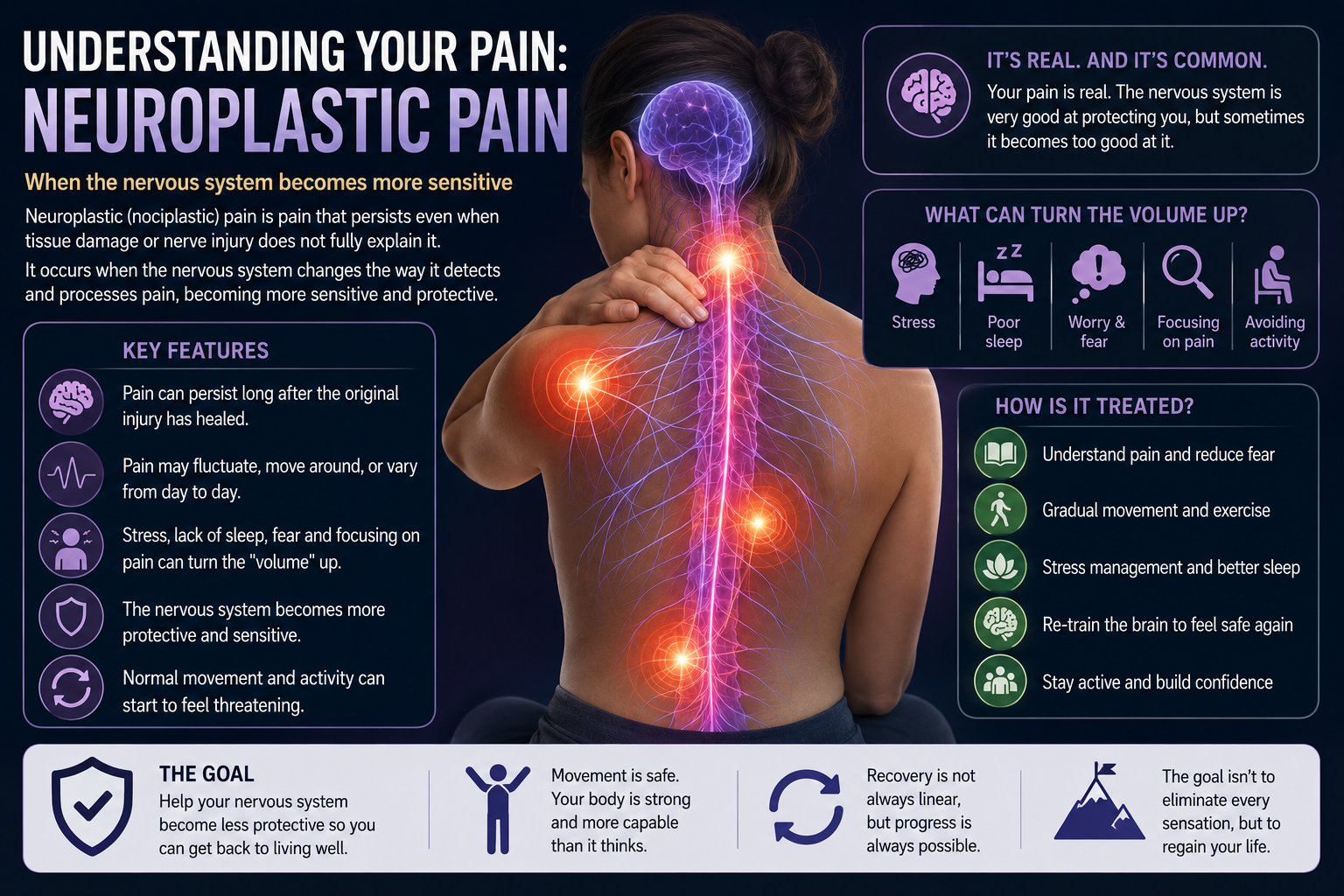
Neuroplastic Pain
In This Article
- What Is Neuroplastic Pain?
- What Does Neuroplastic Pain Feel Like?
- Why Can Pain Persist After Tissues Have Healed?
- What Clues Suggest a Neuroplastic Component?
- How Do Stress, Fear and Attention Affect Pain?
- What If My Scan Shows Degeneration or Disc Changes?
- How Is Neuroplastic Pain Treated?
- Can Massage, Physio or Chiropractic Still Help?
- The Takeaway
This is the third article in my three-part series exploring three important types of pain: nociceptive (musculoskeletal), neuropathic and neuroplastic pain.
In the first two articles, we looked at pain associated with muscles and joints and pain involving the nervous system itself. But what happens when pain persists even though ongoing tissue damage or nerve injury doesn’t adequately explain it?
This is where neuroplastic pain becomes important.
Understanding this type of pain can be particularly important for people who have experienced persistent pain for months or years despite trying multiple treatments.
The pain is very real, but the mechanism maintaining it may have changed.
What Is Neuroplastic Pain?
The term neuroplastic pain is commonly used to describe pain that is maintained, at least partly, by learned or sensitised pain-processing pathways within the nervous system.
The formal clinical term nociplastic pain describes pain arising from altered nociception when there isn’t clear evidence that ongoing tissue damage or a lesion or disease of the somatosensory nervous system fully explains the pain.
Put simply, your nervous system can become more sensitive and protective, producing pain in situations that previously wouldn’t have been painful.
This doesn’t mean the pain is imagined or “all in your head.” The pain is real. What has changed is how the nervous system processes and responds to information from the body.
What Does Neuroplastic Pain Feel Like?
Unlike neuropathic pain, there isn’t one particular sensation that identifies neuroplastic pain.
It can feel remarkably similar to ordinary musculoskeletal pain, including:
- Aching or burning
- Muscle tightness and tension
- Stiffness
- Sharp pain
- Widespread or changing pain
- Increased sensitivity to pressure or movement
This is one reason it can be difficult to recognise.
The clues often come not simply from what the pain feels like, but from the overall pattern of symptoms and how they behave over time.
Why Can Pain Persist After Tissues Have Healed?
Pain is not simply a direct measurement of tissue damage.
Your brain and nervous system continuously interpret information from your body alongside factors such as previous experiences, expectations, context, stress and perceived threat.
Normally, pain reduces as an injury heals.
However, with persistent pain, the nervous system can sometimes become increasingly sensitive. Movements, positions or activities that were originally painful may continue to trigger pain even when ongoing tissue damage no longer adequately explains the symptoms.
A useful way to think about this is that the nervous system has become too good at producing a protective response.
The goal of treatment therefore changes from repeatedly trying to “fix” a painful tissue to helping the nervous system become less protective and regain confidence in normal movement and activity.
What Clues Suggest a Neuroplastic Component?
No single symptom proves that pain is neuroplastic, but certain patterns may increase suspicion.
These can include:
- Pain persisting much longer than expected after an injury
- Symptoms that fluctuate considerably without a clear physical explanation
- Pain that moves or changes location
- Symptoms strongly influenced by stress, fear or emotional state
- Pain triggered by movements that are unlikely to be causing tissue damage
- Multiple treatments providing only temporary relief
- Imaging findings that don’t adequately explain the severity or distribution of symptoms
- Increasing sensitivity to touch, pressure or movement
Importantly, having one or two of these features doesn’t automatically mean your pain is neuroplastic.
Many people also have mixed pain, where genuine musculoskeletal pain and altered pain processing exist together.
How Do Stress, Fear and Attention Affect Pain?
Pain is influenced by much more than the tissues themselves.
Stress, poor sleep, fear of movement, anxiety about damage and constantly monitoring a painful area can all influence how strongly the nervous system responds to sensory information.
This doesn’t mean stress “causes” all persistent pain.
Rather, these factors can act like a volume control, turning the nervous system’s sensitivity up or down.
This also helps explain why someone’s pain can change significantly from one day to another even though the physical structure of their spine hasn’t suddenly changed.
What If My Scan Shows Degeneration or Disc Changes?
One of the biggest barriers to recovery can be the belief that pain automatically means something in the body is damaged.
MRI and X-ray findings such as disc degeneration, disc bulges, arthritis and other age-related changes become increasingly common as we get older and can also be found in people without pain.
This doesn’t mean imaging findings are never important.
It means they need to be interpreted alongside your symptoms, examination and overall clinical presentation rather than automatically assuming every abnormality seen on a scan is responsible for your pain.
For someone with persistent pain, repeatedly being told that their spine is “damaged,” “out of alignment” or “wearing away” may also increase fear and reinforce the belief that normal movement is dangerous.
How Is Neuroplastic Pain Treated?
If altered pain processing is contributing significantly to your symptoms, repeatedly treating the painful muscles or joints may not be enough.
Treatment generally aims to help the nervous system become less sensitive and less protective.
Depending on the individual, this may involve:
- Understanding how persistent pain works
- Gradually returning to feared or painful movements
- Exercise and progressive physical activity
- Improving sleep and general health
- Reducing fear surrounding pain and movement
- Psychologically informed approaches such as cognitive functional therapy
- Approaches that help reinterpret painful sensations as less threatening
The aim isn’t to convince someone that their pain isn’t real.
It’s to help the nervous system learn that movement and normal activity can be safe again.
Can Massage, Physio or Chiropractic Still Help?
Yes, particularly when someone also has a genuine musculoskeletal component to their pain.
Manual treatment can reduce symptoms, improve movement and help someone become more comfortable and confident with activity.
The problem arises when someone becomes dependent on passive treatment because they have been led to believe that something continually needs to be “released,” “realigned” or “put back into place.”
If treatment makes you feel better for a few days but the same pain repeatedly returns for months or years, simply increasing the frequency of treatment may not address why the pain has become persistent.
For someone with a significant neuroplastic component, treatment should increasingly focus on helping them become less fearful of their body, more confident with movement and ultimately less reliant on treatment.
The Takeaway
Persistent pain doesn’t always mean persistent damage.
Sometimes pain begins with a genuine injury or musculoskeletal problem, but over time changes in how the nervous system processes pain can become an increasingly important part of why the symptoms continue.
This is why identifying the predominant pain mechanism matters.
If months or years of repeatedly treating muscles, joints or spinal “alignment” haven’t produced lasting improvement, the answer may not be more of the same treatment.
It may be time to consider whether the nervous system itself has become part of the problem—and whether treatment needs to focus on helping it become less protective rather than repeatedly trying to fix the painful body part.