Skip to main content
Understanding Your Pain: Why the Type of Pain Matters
In This Article
- What Is Nociceptive Pain?
- Myofascial vs Facet Joint Pain
- How Does Your Pain Respond to Treatment?
- What If Both Treatments Help?
- What If Both Treatments Don’t Help?
This is the first in a three-part series exploring three important types of pain: nociceptive (musculoskeletal), neuropathic, and neuroplastic pain.
Understanding the type of pain you may be experiencing can help you choose the right treatment approach. Some people can go to a chiropractor and get great results from adjustments only, experiencing considerable results in only a few appointments; for others, the results can be symptomatic, so they may need to go multiple times a week and ongoing for months. There is usually a science-based reason for this; this article covers the reasons in great depth.
The aim isn’t to help you diagnose yourself, but to better understand why you hurt and what may be contributing to your pain.
Nociceptive Pain- AKA Musculoskeletal Pain
Nociceptive pain occurs when pain-sensitive nerve endings (nociceptors) are activated in tissues such as muscles, fascia, joints, ligaments, and tendons. This is the most common type of pain, and the one I see most commonly in clinic.
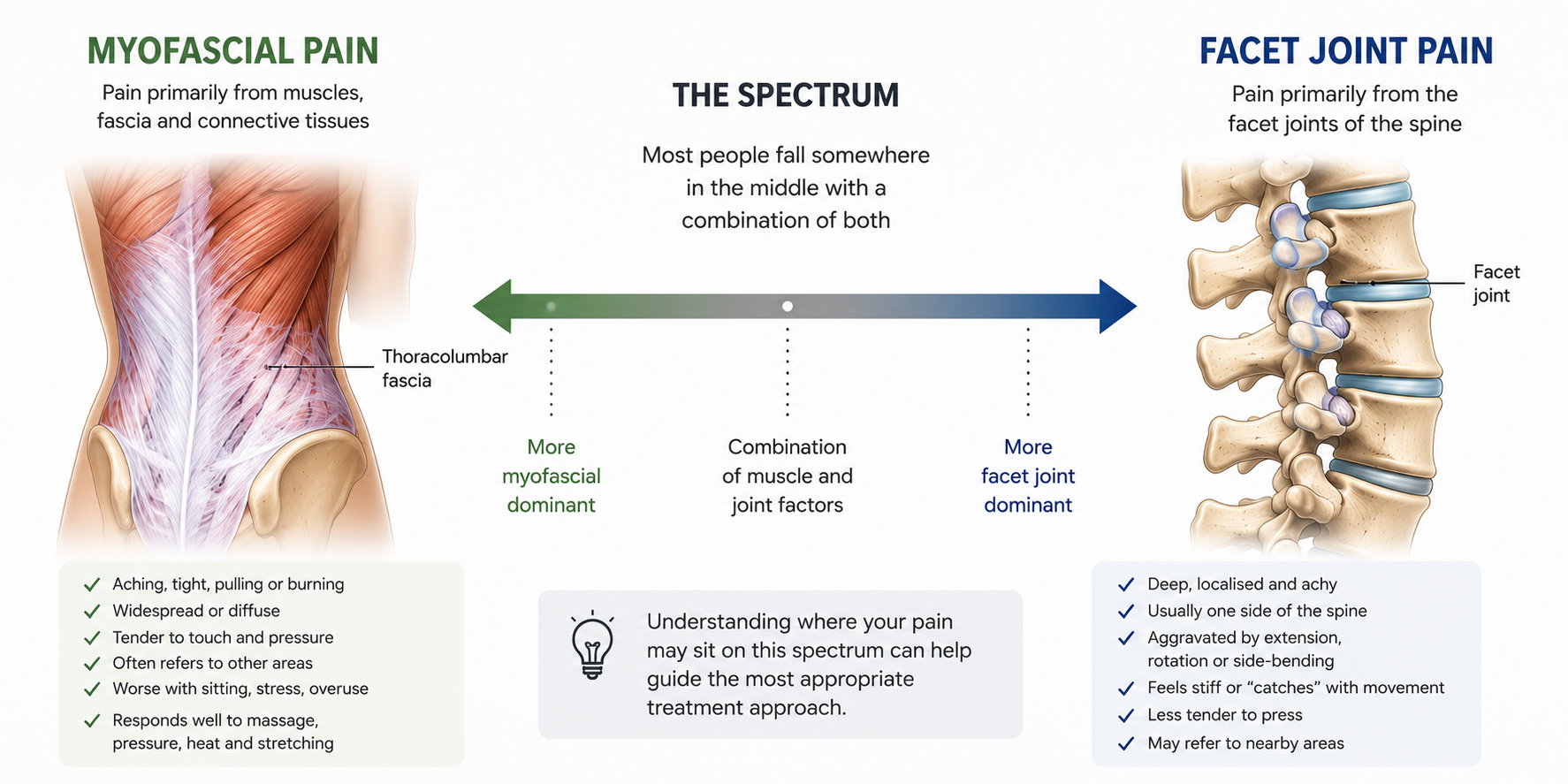
In neck and back pain, two potential contributors are myofascial pain and facet joint pain. These frequently overlap, with many people sitting somewhere on a spectrum between the two.
In my clinical experience, I’d estimate only around 10–20% of people sit predominantly at either end of this spectrum—primarily myofascial or primarily facet-related—with most somewhere in between.
Two useful clues to where you may sit on this spectrum are the characteristics of your pain and how it responds to treatment.
Myofascial Pain vs Facet Joint Pain: What Does Each Feel Like?
Although they can feel very similar, certain characteristics may provide clues as to which is contributing more.
Myofascial Pain
Myofascial pain originates from muscles and their surrounding connective tissues. It is more likely to be:
- Aching, tight, or pulling
- Spread over a broader area
- Associated with muscle tightness or tension
- Reproduced by pressing or massaging tender muscles
- Referred to another area when sensitive points are pressed
- Aggravated by prolonged positions, repetitive activity, or stress
- Temporarily relieved by heat or stretching
Facet Joint Pain
Facet pain originates from the small joints at the back of the spine. It is more likely to be:
- Deep, localised, and achy, sometimes sharp with movement
- Concentrated around one side of the spine
- Aggravated by particular spinal movements, especially extension, rotation, or side-bending
- Associated with stiffness, restriction, or a “catching” sensation
- Less clearly reproduced by pressing or massaging the surrounding muscles
These characteristics aren’t diagnostic tests. Muscle and facet joint pain can produce similar symptoms, which is why response to treatment can provide another useful clue.
How Does Your Pain Respond to Treatment?
A) Why Do My Muscles Feel Relaxed, But My Spine Still Feels Stiff After a Massage?
If massage, myotherapy, or other muscle treatments reduce your aching, tension, and tenderness, but you’re left with localised pain, stiffness, or a catching sensation with certain movements, there may also be a facet joint component.
Something I typically hear is that their pain was improving until they hit a plateau, and felt like the treatment was too general and they often felt they needed to be “cracked”.
B) Why Does My Chiropractor Need to See Me Multiple Times a Week?
An adjustment can still provide good relief even when much of the pain appears to be myofascial; however, it tends to be an indirect effect and short-lived.
Spinal manipulation can produce short-term hypoalgesia, a temporary reduction in pain sensitivity through changes in how pain is processed by the nervous system, including spinal and brain-based pain-modulating mechanisms.
If you feel better after an adjustment but the same aching, tightness, and muscular tenderness returns after a few days, it may indicate that a significant myofascial component is still present.
This can create a familiar cycle:
Adjustment → pain decreases → you feel better → pain returns → another adjustment.
Rather than assuming this automatically means you need more frequent adjustments or a longer treatment plan, it may be worth asking whether the muscular component of your pain is also being adequately addressed.
What If Both Treatments Help?
If muscle treatment relieves the aching and tension while joint treatment improves the remaining deeper pain, stiffness, or restricted movement, you may sit somewhere in the middle of the spectrum.
For these presentations, focusing exclusively on either the muscles or the joints may only address part of the problem.
This is why my approach combines extensive muscle and myofascial work with appropriate chiropractic joint treatment. Rather than assuming every case requires the same treatment, the aim is to identify which components appear most relevant and treat accordingly.
You can read more about this combined approach on my low back treatment page, general neck pain treatment page and my headache treatment page.
The goal shouldn’t simply be to make you feel better until your next appointment. It should be to achieve meaningful improvement while helping you become less reliant on treatment over time.
What If Both Treatments Don’t Help?
If you’re receiving a combination of muscle and joint treatment but the results are still short-lived, in my experience there are two common reasons.
1. The Myofascial Component May Be Insufficient
I’ve worked as a bodywork and sports massage therapist for over 20 years, yet I may still need 30–40 minutes of dedicated myofascial treatment to achieve a meaningful change.
If someone has a significant myofascial component, it’s unrealistic to assume that 10 or 15 minutes of general muscle work, particularly through clothing or primarily using a massage gun, will provide the same effect as thorough, targeted treatment. Often their muscles would still feel “gristly” or like tight ropes.
2. The Pain Mechanism May Have Been Misidentified
If appropriate muscle and joint treatment still only provides short-term relief, or makes very little difference, the problem may not be primarily myofascial or facet-related.
Your pain may have a neuropathic component, such as nerve involvement associated with a disc problem. For example, neck pain associated with arm pain, pins and needles or numbness may require consideration of cervical nerve involvement.
Alternatively, there may be a neuroplastic component, where changes in how the brain and nervous system process pain contribute to symptoms persisting.
These types of pain require a different approach. Continuing to repeatedly treat muscles and joints when they aren’t the primary driver may simply keep you on the “treatment merry-go-round.” I will cover these types of pain in subsequent articles.