Skip to main content
In This Article
- What Is Neuropathic Pain?
- What Does Neuropathic Pain Feel Like?
- Does Travelling Pain Mean a Pinched Nerve?
- How Is Nerve Involvement Assessed?
- Does a Disc Herniation Mean You Need Surgery?
- What About Cortisone Injections?
- Why Can Muscle or Joint Treatment Still Help Temporarily?
- When Does the Treatment Approach Need to Change?
- When Should You Seek Medical Attention?
- The Takeaway
This is the second article in my three-part series exploring nociceptive (musculoskeletal), neuropathic and neuroplastic pain.
In the first article, we looked at nociceptive pain arising from tissues such as muscles, fascia and joints. But what happens when the pain isn’t primarily coming from these tissues?
This is where neuropathic pain becomes important.
Understanding the difference matters because repeatedly treating muscles and joints when the nervous system itself is involved may provide little benefit—or only temporary symptom relief—keeping you on the “treatment merry-go-round.”
The aim isn’t to diagnose yourself, but to help you recognise when your symptoms may warrant a different approach.
What Is Neuropathic Pain?
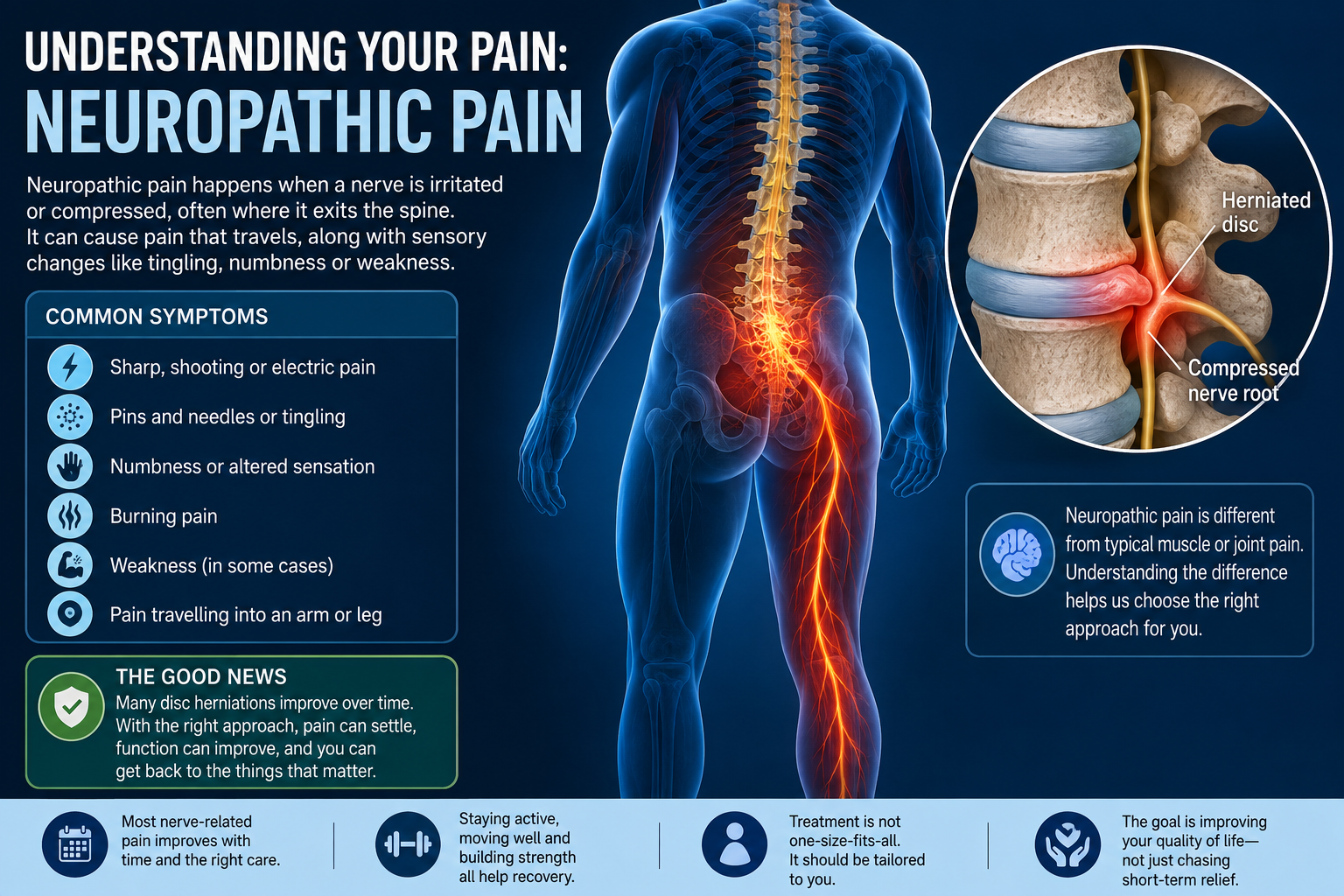
Neuropathic pain is pain caused by a lesion or disease affecting the somatosensory nervous system—the nerves and pathways responsible for sensations such as touch, temperature and pain.
In neck and back pain, an important example is radicular pain, which can occur when a spinal nerve root becomes irritated or compressed.
This may occur with conditions such as:
- Disc herniation
- Degenerative changes around the spine
- Narrowing around the nerve (foraminal stenosis)
- Less commonly, other conditions affecting nerves
In the neck, symptoms may travel into the shoulder, arm or hand. In the lower back, they may travel into the buttock, leg or foot.
What Does Neuropathic Pain Feel Like?
Neuropathic pain often has characteristics that differ from typical muscle or joint pain.
You may experience:
- Burning or electric pain
- Sharp, shooting pain
- Pins and needles or tingling
- Numbness or altered sensation
- Unusual sensitivity of the skin
- Pain travelling into an arm or leg
- Sometimes weakness when motor nerve function is affected
The further symptoms travel into an arm or leg—particularly when accompanied by tingling, numbness or weakness—the more important it becomes to assess possible nerve involvement.
Does Travelling Pain Mean a Pinched Nerve?
Not necessarily.
Muscles, facet joints and other spinal structures can produce referred pain, where pain is experienced away from the structure producing it.
For example, neck structures can refer pain into the shoulder or shoulder blade, while lower-back structures can refer pain into the buttock or thigh.
This is different from radicular pain associated with a spinal nerve root.
Pain that travels does not automatically mean nerve pain.
Neuropathic or radicular pain becomes more likely when travelling pain occurs alongside neurological symptoms such as pins and needles, numbness, altered sensation or weakness, particularly when the distribution is consistent with nerve involvement.
How Is Nerve Involvement Assessed?
An MRI isn’t always the first or most important step.
A physical examination can provide valuable information by assessing:
- Sensation
- Muscle strength
- Reflexes
- Nerve sensitivity or provocation
- The distribution of your symptoms
These findings are considered alongside your history and symptoms.
Imaging may then be appropriate when the findings suggest significant nerve involvement, symptoms aren’t improving as expected, or the result would change how the condition is managed.
Does a Disc Herniation Mean You Need Surgery?
Not necessarily. The scan needs to be interpreted alongside your symptoms, neurological examination, and how you’re progressing clinically. In my experience, a lot of surgeons will wait and see how you progress, unless the pain is unbearable or worsening; then surgery may be recommended.
One of the most frightening things a patient can hear is that an MRI shows a disc bulge, protrusion, extrusion or sequestration.
But the appearance of a disc on an MRI doesn’t automatically determine how much pain you will experience—or whether you’ll need surgery.
Many disc herniations improve with conservative management, and herniated disc material can sometimes shrink or be resorbed naturally by the body.
Interestingly, larger extrusions and sequestrations can be more likely to regress spontaneously than contained protrusions.
This means:
A dramatic-looking MRI doesn’t automatically mean a poor prognosis.
What About Cortisone Injections?
When nerve-root pain is associated with inflammation from a disc herniation, an epidural corticosteroid injection may sometimes be considered to help control symptoms while the condition settles naturally. For some people, it can provide enough pain relief to improve day-to-day function while giving the irritated nerve time to settle and the disc herniation an opportunity to naturally regress or be resorbed by the body.
Why Can Muscle Treatment Still Help?
Having neuropathic or radicular pain doesn’t mean muscles and joints can’t also become painful.
Someone with an irritated nerve root may develop muscular guarding, stiffness and secondary musculoskeletal pain around the neck or back.
Massage and mobilisation may therefore make you temporarily feel better by reducing these associated symptoms and altering pain sensitivity.
But feeling better after treatment doesn’t necessarily prove that a muscle or facet joint was the primary cause.
If the characteristic shooting, burning, tingling or neurological symptoms continue to return, the neurological component needs to be considered.
When Does the Treatment Approach Need to Change?
If you’ve repeatedly received muscle or joint treatment but continue to experience:
- Shooting or electric pain into an arm or leg
- Persistent pins and needles
- Numbness or altered sensation
- Progressive symptoms
- Weakness
The underlying diagnosis and treatment approach may need to be reassessed.
Depending on the presentation, management may involve education, maintaining appropriate activity, exercise and rehabilitation, medication or medical assessment, and in selected cases injections or surgical consultation.
The appropriate approach depends on what is affecting the nerve and how severely neurological function is affected.
When Should You Seek Medical Attention?
Most episodes of radicular pain don’t require emergency treatment, but certain neurological symptoms require prompt assessment.
Seek medical attention if you develop new or progressive muscle weakness, significant worsening numbness, major changes in coordination or walking, or rapidly worsening neurological symptoms.
Certain combinations of lower-back pain with changes in bladder or bowel function or numbness around the saddle or genital region require urgent medical assessment.
The Takeaway
Neuropathic pain is fundamentally different from ordinary muscle or joint pain.
If your symptoms include burning, shooting or electric pain, pins and needles, numbness, altered sensation or weakness, particularly when travelling into an arm or leg, nerve involvement should be considered.
Just as importantly:
Finding a disc problem on an MRI doesn’t automatically mean surgery, while temporary improvement following muscle or joint treatment doesn’t necessarily mean the problem is musculoskeletal.
If treatment repeatedly provides only short-term relief, the answer isn’t automatically more treatment. It may be time to reconsider what type of pain is actually being treated.
In Part 3, we’ll look at neuroplastic pain—where persistent pain can become increasingly influenced by changes in how the brain and nervous system process threat and pain, even when ongoing tissue injury doesn’t adequately explain the symptoms.